Every Misclassification Costs Money.
E-waste management and valorisation, powered by agentic AI. Real-time vision, mechanized sorting, and circular data intelligence — driving compliance, recovery, and new revenue streams.
Three Challenges Converging, without an Integrated Solution
Operations, sustainability, and compliance — each one alone is complex. Together, they demand a fundamentally new approach.
E-Waste's Triple Test
Operations & Economics
- × Inconsistent sorting — accuracy varies by shift and operator
- × Expensive safe processing with scarce metal recovery per device
- × No product-level traceability or data intelligence
- × A single misclassified item contaminates an entire batch
Sustainability
- × Less than a quarter of global e-waste is properly recycled
- × Lithium, cobalt, rare earths — overwhelmingly lost to landfills
- × No granular data for ESG targets or Scope 3 reporting
- × Repair and reuse decisions impossible without device-level data
Compliance
- × Recycling targets tighten every year — falling short means fines and lost contracts
- × New traceability requirements with no infrastructure to meet them
- × Digital Product Passport mandates approaching with no data pipeline in place
- × Non-compliance triggers penalties, contract exclusions, and reputational damage
E-Waste Management and Valorisation
Operations & Economics
- Mechanized AI sorting with consistent accuracy, 24/7
- Higher throughput with fewer operators at higher productivity
- Instant waste data classification from camera to action
- Data valorisation — turning waste flow into circularity insights
Sustainability
- Deep Analysis — physical condition assessment for repair, reuse, or recover
- Bill of Materials analysis and quantification at the component level
- Critical rare-earth mineral identification and recovery
- Digital Product Passport generation per device
- Reduce: landfill waste and pollutants
- Device eco-design and circularity insights
Compliance
- Audit-ready documentation generated at belt speed
- Full lifecycle transparency and material composition tracking
- End-to-end traceability and targeted recovery of strategic materials
- Fair billing — exact device-level data for producer attribution
- Scope 3 emissions reporting with granular GHG data
What Elysium Delivers
Continuous AI Vision
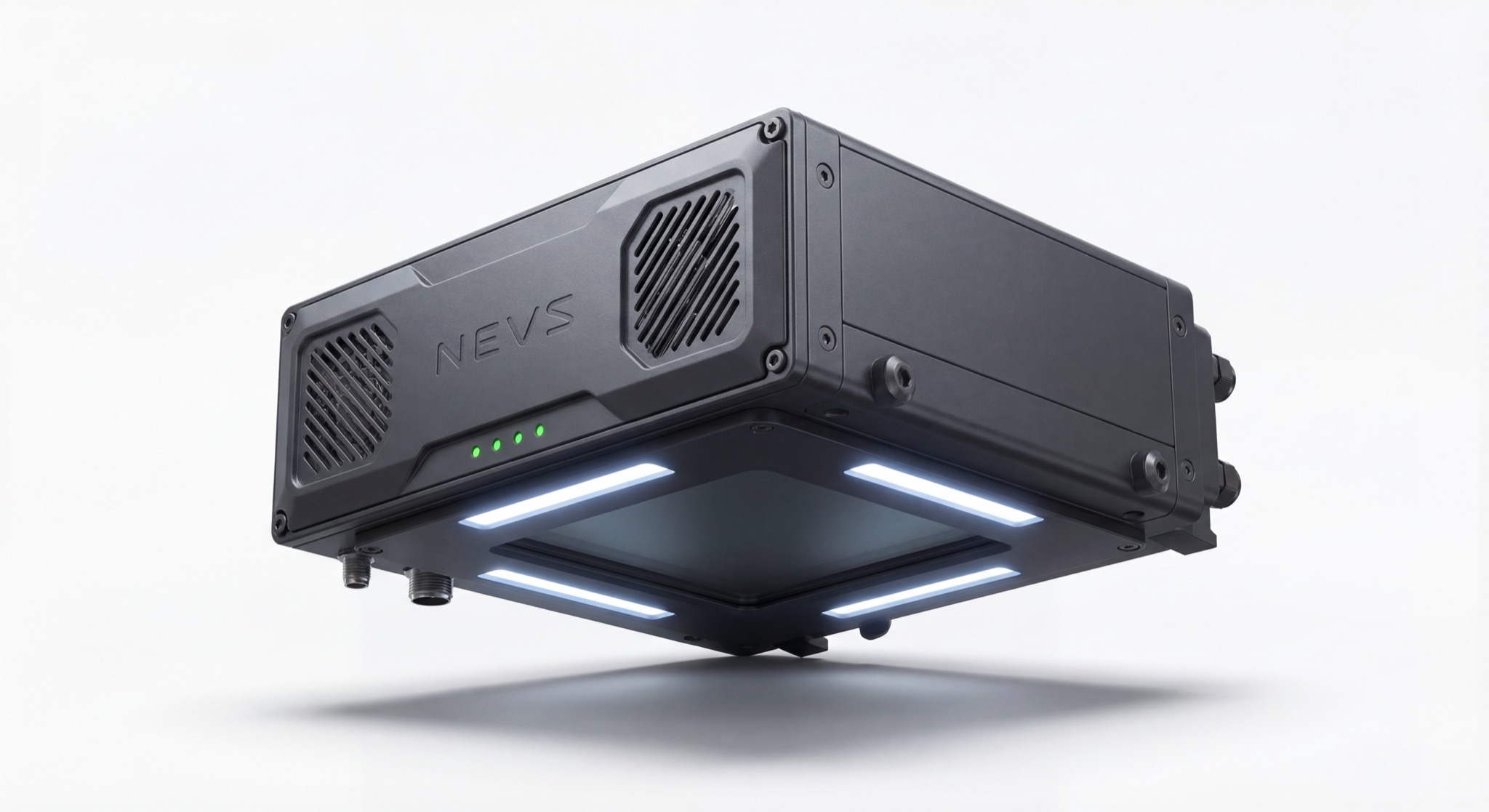
Multi-sensor fusion identifies and classifies every item on the sorting belt at belt speed.
Mechanized Sorting
Consistent AI-driven classification eliminates shift-to-shift accuracy variation.
Multi-Sensor Fusion
3D cameras, infrared, and X-ray working together for maximum classification accuracy.
Operator + AR/VR Guidance
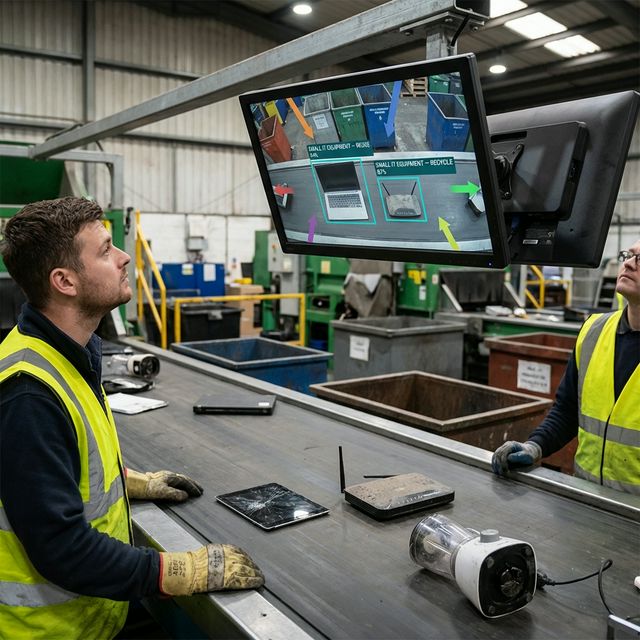
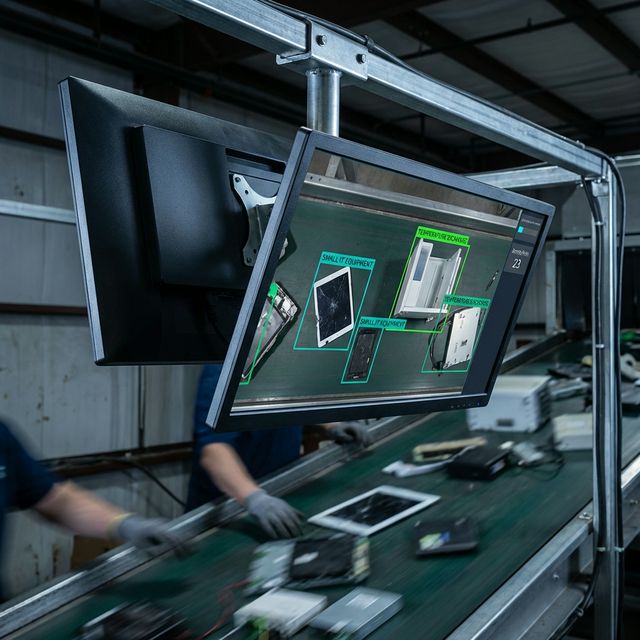
Live visual overlays guide operators with AI-powered classification at belt speed.
Why AI Waste Sorting Matters Now
AI-driven WEEE sorting is in its earliest stages — fragmented pilots, single-fraction solutions.
The window for full-line, end-to-end AI sorting is closing fast.
Triple Bottom Line Across the Value Chain
Elysium creates value for every stakeholder in the e-waste ecosystem — strengthening the business case for circularity.
Producers & Brand Owners
Add value, protect reputation
- Enhance brand equity through verified sustainable practices
- Data-driven eco-design insights from end-of-life intelligence
- Traceability & compliance reporting for EU obligations
- Fair producer billing through accurate device attribution
PROs & Sorting Facilities
Reduce costs, unlock revenue
- Mitigate penalties and cleanup costs from misclassification
- Recovery of critical & hazardous components (batteries, rare earths)
- New revenue streams through data valorisation
- Higher operational efficiency with mechanized sorting
Circularity Ecosystem
Municipalities, governments, regulators
- Data-driven insights enabling circular value chains
- Reduction in landfill waste, improved EU target compliance
- Sustainability index tracking for corporate strategic KPIs
- Competitive advantage for regions adopting AI-driven circularity
Driving Europe’s Green and Digital Transition
AI-powered sorting directly supports EU objectives for circular economy, digital traceability, and sustainable production.
WEEE Directive
- Recycling & reuse targets
- Accurate classification at belt speed
- Audit-ready reporting and documentation
Ecodesign for Sustainable Products (ESPR)
- Digital Product Passport data generation
- Lifecycle transparency for producers
- Material composition tracking
Critical Raw Materials Act
- Recovery of strategic materials (rare earths, lithium, cobalt)
- Traceability of critical raw materials
- Reducing EU import dependency
Elysium helps PROs meet every framework from a single platform — turning compliance into competitive advantage.
Auditable AI Built for European Standards
As the EU turns AI security into auditable infrastructure, Elysium is designed from the ground up to meet emerging standards — including EN 304 223 cybersecurity requirements for AI systems.
Lifecycle Security
Secure design, development, deployment, maintenance, and end-of-life — aligned with ETSI EN 304 223 framework.
On-Premises Processing
All AI inference runs on-device. No video or data leaves your facility. Sovereign AI by architecture.
Accountability by Design
Clear ownership across developers, operators, and data custodians — with audit-ready documentation at every stage.
Privacy by Architecture
Elysium runs all AI inference on-premises — no video or classification data leaves your facility.
From Belt to Operator in Under 100ms
Capture
3D cameras acquire frames
Detect
Objects isolated on belt
Classify
AI assigns category + confidence
Transmit
Results sent via fiber
Render
Visual overlay generated
Display
Operator sees guidance
Elysium in Action

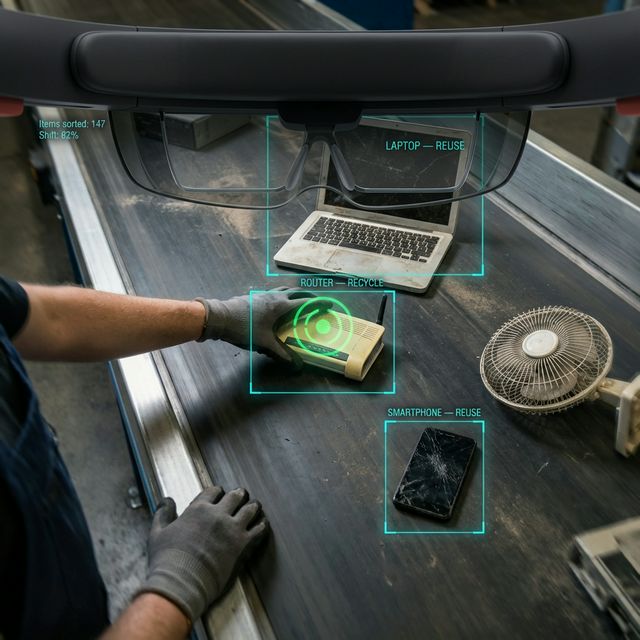
Common Questions About Elysium
How does Elysium classify WEEE waste?
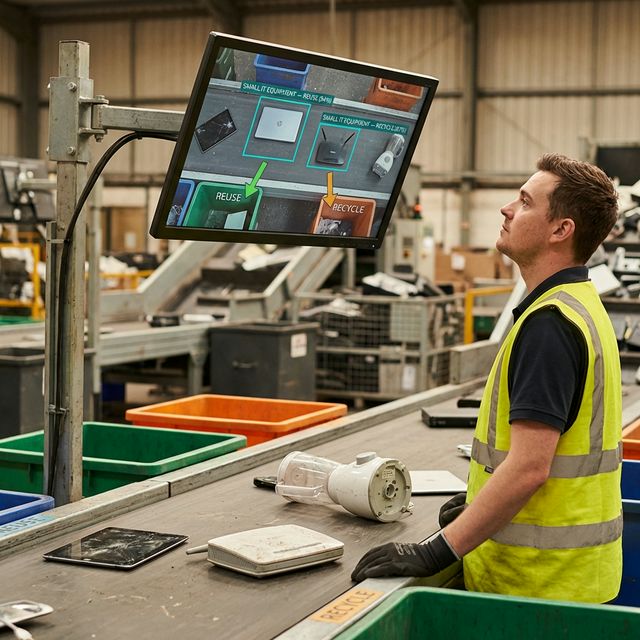
Elysium uses continuous computer vision to identify and classify waste items on the sorting belt. Edge AI models detect product categories — including small household appliances, IT equipment, screens, and large appliances — and provide operators with instant classification guidance on-screen, at belt speed.
What accuracy does Elysium achieve?
Elysium achieves macro-classification accuracy rates significantly above manual sorting benchmarks. The system continuously improves as it processes more items, adapting to new product types and site-specific waste streams over time.
What EU regulations does Elysium address?
Elysium directly supports compliance with the EU WEEE Directive (2012/19/EU), which mandates proper collection, treatment, and recycling of electrical and electronic equipment waste. The system helps operators meet classification accuracy requirements and generates audit-ready documentation for regulatory reporting.
Can Elysium work alongside existing sorting lines?
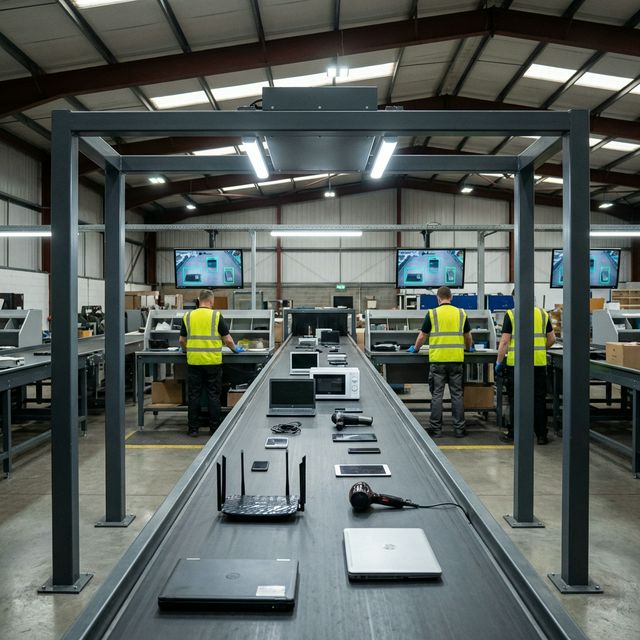
Yes. Elysium is designed as an augmentation layer, not a replacement. It integrates with existing conveyor belt infrastructure and operator workflows. Camera units and edge devices are installed above the sorting line, and classification guidance is delivered via existing screens or dedicated displays at each station.
What's the ROI of deploying Elysium?
Elysium reduces misclassification-related penalties, lowers re-sorting costs, and improves throughput — directly impacting the bottom line. Facilities typically see payback within the first year through reduced fines, improved material recovery rates, and more efficient operator performance.
Sources
- 62M tonnes, <23% recycled, $91B in materials — Global E-waste Monitor 2024, ITU/UNITAR
- <1% rare earth recovery from e-waste — IEA — Recycling of Critical Minerals, 2024
- EU WEEE collection rate: 37.5% — Eurostat — WEEE Statistics, 2023
- ESPR in force since July 2024 — EU Ecodesign for Sustainable Products Regulation
- Critical Raw Materials Act in force since May 2024 — EU CRM Act (Regulation 2024/1252)